Fledgling by Octavia E. Butler is a novel about vampires and therefore involves science fiction and horror writing styles. Science fiction and horror in this novel seem to be identified with futuristic ideas, fear of death, and inhuman and unknown ideas or objects. These are all seen in the relationship between Shori and Wright.
Futuristic ideas are shown with the genetic engineering of Shori. Shori is part human and part vampire and was genetically engineered to have dark skin which would more fully protect her from the sunlight which greatly injures other vampires. The vampires (Ina) in this novel are well ahead of humans in this area of science.
Fear of death is brought about by Wright thinking that he will die if he no longer has contact with Shori. This fear of death creates a stronger dependence on Shori and her venom. The vampires and many aspects about them show inhuman and unknown ideas or objects. The idea of vampires being real is pretty far fetched in society today but in this novel Wright automatically believes that Shori is a vampire.
All of these aspects of the novel show that it is science fiction and horror.
Tuesday, October 30, 2007

Tuesday, October 23, 2007
Social and Racial Allegories in The Intuitionist
This novel contains many ideas that all lead to the main allegories of the novel which are that of social and racial status. Some of these aspects of the novel are that of James Fulton and the hiding of his racial identity and the idea of the black box transcending barriers. These ideas in the novel are very important and have many meanings behind them.
James Fulton's being "colored" but portraying himself as white to pass an idea that is in reality a joke is very influential to the allegories of race and social standing. James Fulton had to disguise himself as something he wasn't to succeed in society, he had to break barriers and limitations. The revealing of Fulton as an African American breaks all the social and racial barriers that are presented in the society at this time.
The idea of the black box being undefinable to society and the use of it to transcend social and racial limitations is also very important. This idea shows the black box ending social stigma and revealing the superficial as no longer the deeming factor in society. The black box can also never be wrong just as Lila Mae because it is what someone wants it to be, there are no limits.
This novel shows many ideas revolving around the transcendence of race and social standing. These ideas play a very important role in the revealing of the allegories present.
James Fulton's being "colored" but portraying himself as white to pass an idea that is in reality a joke is very influential to the allegories of race and social standing. James Fulton had to disguise himself as something he wasn't to succeed in society, he had to break barriers and limitations. The revealing of Fulton as an African American breaks all the social and racial barriers that are presented in the society at this time.
The idea of the black box being undefinable to society and the use of it to transcend social and racial limitations is also very important. This idea shows the black box ending social stigma and revealing the superficial as no longer the deeming factor in society. The black box can also never be wrong just as Lila Mae because it is what someone wants it to be, there are no limits.
This novel shows many ideas revolving around the transcendence of race and social standing. These ideas play a very important role in the revealing of the allegories present.
Tuesday, October 16, 2007
The Intuitionist
In the novel The Intuitionist there is a great sense of dislocation which contributes to the great allegory that Whitehead is trying to portray. This novel may seem to be about elevators but it is in fact merely a metaphor for something larger. This metaphor could very well relate to race, being dislocated, or to the ideas of heaven and hell.
The dislocation present in this novel is that of time period, region, and African Americans among the mostly Irish whites. The dislocation is a conscious one used by Whitehead to create the ambiguity that is necessary for his allegory. Some of the things that cause confusion in the time period are the language and the scientific ideas presented. For example, Whitehead uses the word "colored" in place of black, which is a non-contemporary language choice. The scientific ideas shown through the elevators having spirits and such show a time period that could be in the future. There are many examples of the varying time period questionableness in this novel. The dislocation is conscious because of the fact that Whitehead wants this story to relate to all times and all places. This novel shows dislocation through the cloudy/unclear explanations of the characters and events. This cloudy uncertainty relates to the African American community in this novel being "lost" among the white community.
The concepts behind the far fetched elevator Intuitionist beliefs are that of heaven and ascension compared to hell. These are ideas are still unclear at this point in the novel but the ascension of the escalator compared to the elevator is definitely a metaphor towards spirituality and religious thought. So with all of this, does is now make sense why the reader can't comprehend the novel well if they don't suspend their disbelief? I think so.
The dislocation present in this novel is that of time period, region, and African Americans among the mostly Irish whites. The dislocation is a conscious one used by Whitehead to create the ambiguity that is necessary for his allegory. Some of the things that cause confusion in the time period are the language and the scientific ideas presented. For example, Whitehead uses the word "colored" in place of black, which is a non-contemporary language choice. The scientific ideas shown through the elevators having spirits and such show a time period that could be in the future. There are many examples of the varying time period questionableness in this novel. The dislocation is conscious because of the fact that Whitehead wants this story to relate to all times and all places. This novel shows dislocation through the cloudy/unclear explanations of the characters and events. This cloudy uncertainty relates to the African American community in this novel being "lost" among the white community.
The concepts behind the far fetched elevator Intuitionist beliefs are that of heaven and ascension compared to hell. These are ideas are still unclear at this point in the novel but the ascension of the escalator compared to the elevator is definitely a metaphor towards spirituality and religious thought. So with all of this, does is now make sense why the reader can't comprehend the novel well if they don't suspend their disbelief? I think so.
Monday, October 8, 2007
Hagar in the Bible
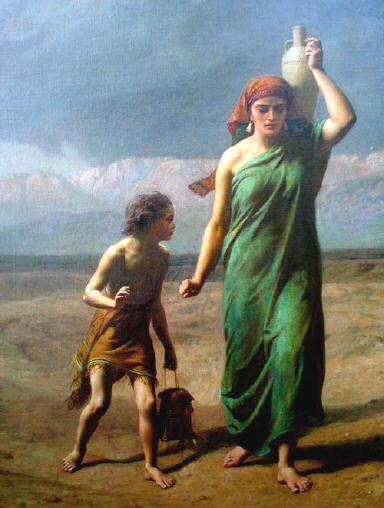
Hagar was an Egyptian maid of Abraham's wife Sarah. Sarah gave Hagar to Abraham for fertility purposes because she was infertile, saying "The Lord has kept me from having children. Go sleep with my maid-servant; perhaps I can build a family through her" (Genesis 16:2). Abraham and Hagar then had a son named Ishmael. Some time later God blessed Sarah and Abraham with a son named Isaac. Sarah ordered Abraham to send Hagar and Ishmael away by telling him "Get rid of that slave woman and her son, for that slave woman's son will never share the inheritance with my son Isaac" (Genesis 21:10). Abraham consulted God and God said that it was the right thing to do and not to worry because he "[would] make the son of the maidservant into a nation also, because he is your offspring" (Genesis 21:13). So Abraham sent Hagar and Ismael away and as they were traveling they got lost in the desert. Hagar left Ishmael under a tree while she went to find water. She was blessed by God who showed unto her a well. Hagar and Ishmael lived in the Desert of Paran where Ishmael became and archer and acquired a wife from Egypt.
The African American community uses this story to pertain to their life and their displacement. It also refers to a model of a single mother and her child trying to make a life although the struggles are great. This story is used by African Americans for the idea that anything can be done with only God on your side and it also creates the sense of true struggle that was and has been experienced by the African American community.
Sunday, September 30, 2007
Old Boys, Old Girls
This story from All Aunt Hagar's Children is one that stood out to me with the expression of humanity and the loss thereof. This story also deals with the burden of family and struggles entailed with that. It is a story about Caesar who has killed two people and ended up in prison after the second murder. Many parts of this story portray him as trying to find his humanity that he lost more and more every day while in prison. He deals with family issues which end up pushing him away from the discovery of humanity which he so desires.
"Caes you gon be here a few days, so you can't let nobody fuck with our humanity." This point in the story is when the author makes it obvious to the reader that Caesar is going to experience some sort of issue with his humanity and the need to defend it. Caesar goes through many things in prison that make him defend other aspects of his life but no matter what he still keeps losing his humanity.
When he gets out of prison he doesn't want to interact with his family because he doesn't want them to see this loss in him. He does whatever he can to not have to confront his family but with the pressure of his brother he agrees to a family dinner. At this dinner hope is seen in the area of regaining his lost humanity. However, after the dinner the hope is completely diminished. Caesar realizes with his sisters accusatory look, in reference to him being a child molester, that his humanity is completely gone with no hope of return. His own family cannot see who he is so how can anyone else?
There is one more instance in which he believes he can recover his identity and humanity and that is with the appearance of Yvonne. Yvonne, for Caesar, represents his past life when he had these things, when someone knew who he was. Yvonne however does not recognize him (another reference to lost humanity) and also dies. The hope of a relationship with Yvonne and the idea of someone asking nothing of him crashes down. When he is cleaning her apartment he shows humanity in that he is creating her to be what he used to know her as.
These are just some of the ideas in this story revolving around family and humanity and these themes seem to be apparent in other stories in this novel.
"Caes you gon be here a few days, so you can't let nobody fuck with our humanity." This point in the story is when the author makes it obvious to the reader that Caesar is going to experience some sort of issue with his humanity and the need to defend it. Caesar goes through many things in prison that make him defend other aspects of his life but no matter what he still keeps losing his humanity.
When he gets out of prison he doesn't want to interact with his family because he doesn't want them to see this loss in him. He does whatever he can to not have to confront his family but with the pressure of his brother he agrees to a family dinner. At this dinner hope is seen in the area of regaining his lost humanity. However, after the dinner the hope is completely diminished. Caesar realizes with his sisters accusatory look, in reference to him being a child molester, that his humanity is completely gone with no hope of return. His own family cannot see who he is so how can anyone else?
There is one more instance in which he believes he can recover his identity and humanity and that is with the appearance of Yvonne. Yvonne, for Caesar, represents his past life when he had these things, when someone knew who he was. Yvonne however does not recognize him (another reference to lost humanity) and also dies. The hope of a relationship with Yvonne and the idea of someone asking nothing of him crashes down. When he is cleaning her apartment he shows humanity in that he is creating her to be what he used to know her as.
These are just some of the ideas in this story revolving around family and humanity and these themes seem to be apparent in other stories in this novel.
Monday, September 24, 2007
Paradise and The Dew Breaker
In this blog I will be discussing some of the differences and similarities of Paradise by Toni Morrison and The Dew Breaker by Edwidge Danticat. The three questions that will be discussed are: 1. What role does race play in both of these novels?
2. Why are these novels considered African-American Literature and what defines this genre?
3. How is whiteness apparent in these novels?
Both of these novels raise discussion in these areas. By addressing the first question it is seen that race differs in its uses in both of these novels. In Paradise race is seen through the 8-rocks and their desire of dark skin. In this novel there is also mention of the white race in a couple of instances; however, it is not extremely apparent. The white girl that is shot is made to seem less important than all of the other women at the convent who are of colored skin. This shows that the community of Ruby and the people therein are very set in their own race and don't want any sort of integration in their lives. There seems to be a similar case in The Dew Breaker with little to no mention of another race. The people of Haiti although they have come to America seem to have a very strong sense of self when surrounded by their own race. Only slight mentions of white people are shown in this novel (eg. Miss Hinds). It is different in how the characters in Paradise don't want any integration at all and make many references to race while the characters in The Dew Breaker emerge themselves into another culture and make hardly any mention of it.
The second question can be answered any many ways yet there is still the ambiguity of what really is African American Literature. In class the idea was thrown around that African American Literature can be classified by being about the African American people and their struggles. This could be true even if the author was not African American; however, it does help to have the credibility that an African American author would have. This topic is very debatable and there any many ideas within.
The third question was already partially answered in the race question. The appearance of whiteness in these novels differs in slight ways. There are only a few mentions of white people in both of these novels and this shows the way race is important but also segregated at the time periods in which the novels take place. These questions are very important in the determining of factors of African American novels in that they raise more questions and cause the reader to think more throughly about what classifies a certain novel as African American and the parts, such as race, within the novel that make it so.
2. Why are these novels considered African-American Literature and what defines this genre?
3. How is whiteness apparent in these novels?
Both of these novels raise discussion in these areas. By addressing the first question it is seen that race differs in its uses in both of these novels. In Paradise race is seen through the 8-rocks and their desire of dark skin. In this novel there is also mention of the white race in a couple of instances; however, it is not extremely apparent. The white girl that is shot is made to seem less important than all of the other women at the convent who are of colored skin. This shows that the community of Ruby and the people therein are very set in their own race and don't want any sort of integration in their lives. There seems to be a similar case in The Dew Breaker with little to no mention of another race. The people of Haiti although they have come to America seem to have a very strong sense of self when surrounded by their own race. Only slight mentions of white people are shown in this novel (eg. Miss Hinds). It is different in how the characters in Paradise don't want any integration at all and make many references to race while the characters in The Dew Breaker emerge themselves into another culture and make hardly any mention of it.
The second question can be answered any many ways yet there is still the ambiguity of what really is African American Literature. In class the idea was thrown around that African American Literature can be classified by being about the African American people and their struggles. This could be true even if the author was not African American; however, it does help to have the credibility that an African American author would have. This topic is very debatable and there any many ideas within.
The third question was already partially answered in the race question. The appearance of whiteness in these novels differs in slight ways. There are only a few mentions of white people in both of these novels and this shows the way race is important but also segregated at the time periods in which the novels take place. These questions are very important in the determining of factors of African American novels in that they raise more questions and cause the reader to think more throughly about what classifies a certain novel as African American and the parts, such as race, within the novel that make it so.
Friday, September 14, 2007
Trauma and absence in Danticat's "The Dew Breaker"
In The Dew Breaker by Edwidge Danticat the ideas of trauma and absence are very prevalent. The characters in this novel all experience some kind of trauma or loss resulting in an absence. Danticat uses these two themes to create a common connection between the characters and their lives both separately and combined. For Ka trauma is defined through what she thought her father was and also through her coming to know her real father and his past. Ka used her father as inspiration not only for her art but in her life choices. When she finds out that her father was a hated man in Haiti she loses inspiration, trust, and beliefs. In my African American Literature class we discussed how each of us would react to finding out about deceptions by our fathers and there were a couple different thoughts on this. Many said that they would be upset or angry with their father because of the fact that he lied while others said that they would feel sorry for him because of the fact that he had to hide this for so many years. I think that it would be interesting to hear other people's opinions and reactions to some of the other traumatic events in the novel and relate them to how people in the novel react to trauma such as this. I believe that this would give insight in many ways to the characters and their actions and to the author as well.
Some examples of trauma in the novel are Nadine and the waterchild, Ms. Hinds losing her voice, Estine and Dany's parents dieing, and Claude killing his father and returning to Haiti not knowing Creole. In my opinion, Dany has the most apparent trauma that he is dealing with in his life. He has experienced loss numerous times and is dealing with revenge and confusion in many ways. Dany, after experiencing all of his own trauma is left to deal with that of Claude. I believe that because I haven't finished the novel and am only on page 141 i don't quite understand how to conclude the ideas of trauma and absence. If anyone ever reads this and wants to know more, I will be expanding upon it at a later time after I finish the novel.
There are a few more topics that i would like to cover in this blog and they include that of epiphenomenal subjectivity and how the characters relate to this, similarities and differences in the chapters, and absence in reference to identity. So on the note of subjectivity and such, it is apparent in the novel that the characters revolve around phenomenon that is occurring in their world at the time and they seem to be defined by this. Their lives are what show the epiphenomonal aspect in that they have residual things happening in their lives that are all related, in some way, to the bigger situations at hand. The chapters show this aspect or idea very well through the form and references therein. In the chapter "The Book of The Dead" Ka experiences the death of her ideas of her father while there are references to death in many other instances. In the chapter "The Book of Miracles" Anne, Ka's mother, sees the father's indiscretions and his transformation from that part of his life as a miracle while there are many other stories about miracles in the lives of others. There are other references to this as well but i would like to move onto the idea of absence as identity or lack thereof. Absence as stated earlier is very apparent and I think that the idea of it relating to identity is very important. There are many instances wherein absence creates identity including Estine's loss of sight leading to heightening of other senses to create another version of sight, and Dany's absence of parents and family creating his acceptance of others and perhaps leading to his uncertainty. All of these ideas are just starting to form in the area of the novel that I am at and therefore I will have to expand upon this at the conclusion of the novel. I hope this provokes thought in the readers of it and if there are any questions or comments feel free.
Some examples of trauma in the novel are Nadine and the waterchild, Ms. Hinds losing her voice, Estine and Dany's parents dieing, and Claude killing his father and returning to Haiti not knowing Creole. In my opinion, Dany has the most apparent trauma that he is dealing with in his life. He has experienced loss numerous times and is dealing with revenge and confusion in many ways. Dany, after experiencing all of his own trauma is left to deal with that of Claude. I believe that because I haven't finished the novel and am only on page 141 i don't quite understand how to conclude the ideas of trauma and absence. If anyone ever reads this and wants to know more, I will be expanding upon it at a later time after I finish the novel.
There are a few more topics that i would like to cover in this blog and they include that of epiphenomenal subjectivity and how the characters relate to this, similarities and differences in the chapters, and absence in reference to identity. So on the note of subjectivity and such, it is apparent in the novel that the characters revolve around phenomenon that is occurring in their world at the time and they seem to be defined by this. Their lives are what show the epiphenomonal aspect in that they have residual things happening in their lives that are all related, in some way, to the bigger situations at hand. The chapters show this aspect or idea very well through the form and references therein. In the chapter "The Book of The Dead" Ka experiences the death of her ideas of her father while there are references to death in many other instances. In the chapter "The Book of Miracles" Anne, Ka's mother, sees the father's indiscretions and his transformation from that part of his life as a miracle while there are many other stories about miracles in the lives of others. There are other references to this as well but i would like to move onto the idea of absence as identity or lack thereof. Absence as stated earlier is very apparent and I think that the idea of it relating to identity is very important. There are many instances wherein absence creates identity including Estine's loss of sight leading to heightening of other senses to create another version of sight, and Dany's absence of parents and family creating his acceptance of others and perhaps leading to his uncertainty. All of these ideas are just starting to form in the area of the novel that I am at and therefore I will have to expand upon this at the conclusion of the novel. I hope this provokes thought in the readers of it and if there are any questions or comments feel free.
Subscribe to:
Posts (Atom)
