Fledgling by Octavia E. Butler is a novel about vampires and therefore involves science fiction and horror writing styles. Science fiction and horror in this novel seem to be identified with futuristic ideas, fear of death, and inhuman and unknown ideas or objects. These are all seen in the relationship between Shori and Wright.
Futuristic ideas are shown with the genetic engineering of Shori. Shori is part human and part vampire and was genetically engineered to have dark skin which would more fully protect her from the sunlight which greatly injures other vampires. The vampires (Ina) in this novel are well ahead of humans in this area of science.
Fear of death is brought about by Wright thinking that he will die if he no longer has contact with Shori. This fear of death creates a stronger dependence on Shori and her venom. The vampires and many aspects about them show inhuman and unknown ideas or objects. The idea of vampires being real is pretty far fetched in society today but in this novel Wright automatically believes that Shori is a vampire.
All of these aspects of the novel show that it is science fiction and horror.
Tuesday, October 30, 2007

Tuesday, October 23, 2007
Social and Racial Allegories in The Intuitionist
This novel contains many ideas that all lead to the main allegories of the novel which are that of social and racial status. Some of these aspects of the novel are that of James Fulton and the hiding of his racial identity and the idea of the black box transcending barriers. These ideas in the novel are very important and have many meanings behind them.
James Fulton's being "colored" but portraying himself as white to pass an idea that is in reality a joke is very influential to the allegories of race and social standing. James Fulton had to disguise himself as something he wasn't to succeed in society, he had to break barriers and limitations. The revealing of Fulton as an African American breaks all the social and racial barriers that are presented in the society at this time.
The idea of the black box being undefinable to society and the use of it to transcend social and racial limitations is also very important. This idea shows the black box ending social stigma and revealing the superficial as no longer the deeming factor in society. The black box can also never be wrong just as Lila Mae because it is what someone wants it to be, there are no limits.
This novel shows many ideas revolving around the transcendence of race and social standing. These ideas play a very important role in the revealing of the allegories present.
James Fulton's being "colored" but portraying himself as white to pass an idea that is in reality a joke is very influential to the allegories of race and social standing. James Fulton had to disguise himself as something he wasn't to succeed in society, he had to break barriers and limitations. The revealing of Fulton as an African American breaks all the social and racial barriers that are presented in the society at this time.
The idea of the black box being undefinable to society and the use of it to transcend social and racial limitations is also very important. This idea shows the black box ending social stigma and revealing the superficial as no longer the deeming factor in society. The black box can also never be wrong just as Lila Mae because it is what someone wants it to be, there are no limits.
This novel shows many ideas revolving around the transcendence of race and social standing. These ideas play a very important role in the revealing of the allegories present.
Tuesday, October 16, 2007
The Intuitionist
In the novel The Intuitionist there is a great sense of dislocation which contributes to the great allegory that Whitehead is trying to portray. This novel may seem to be about elevators but it is in fact merely a metaphor for something larger. This metaphor could very well relate to race, being dislocated, or to the ideas of heaven and hell.
The dislocation present in this novel is that of time period, region, and African Americans among the mostly Irish whites. The dislocation is a conscious one used by Whitehead to create the ambiguity that is necessary for his allegory. Some of the things that cause confusion in the time period are the language and the scientific ideas presented. For example, Whitehead uses the word "colored" in place of black, which is a non-contemporary language choice. The scientific ideas shown through the elevators having spirits and such show a time period that could be in the future. There are many examples of the varying time period questionableness in this novel. The dislocation is conscious because of the fact that Whitehead wants this story to relate to all times and all places. This novel shows dislocation through the cloudy/unclear explanations of the characters and events. This cloudy uncertainty relates to the African American community in this novel being "lost" among the white community.
The concepts behind the far fetched elevator Intuitionist beliefs are that of heaven and ascension compared to hell. These are ideas are still unclear at this point in the novel but the ascension of the escalator compared to the elevator is definitely a metaphor towards spirituality and religious thought. So with all of this, does is now make sense why the reader can't comprehend the novel well if they don't suspend their disbelief? I think so.
The dislocation present in this novel is that of time period, region, and African Americans among the mostly Irish whites. The dislocation is a conscious one used by Whitehead to create the ambiguity that is necessary for his allegory. Some of the things that cause confusion in the time period are the language and the scientific ideas presented. For example, Whitehead uses the word "colored" in place of black, which is a non-contemporary language choice. The scientific ideas shown through the elevators having spirits and such show a time period that could be in the future. There are many examples of the varying time period questionableness in this novel. The dislocation is conscious because of the fact that Whitehead wants this story to relate to all times and all places. This novel shows dislocation through the cloudy/unclear explanations of the characters and events. This cloudy uncertainty relates to the African American community in this novel being "lost" among the white community.
The concepts behind the far fetched elevator Intuitionist beliefs are that of heaven and ascension compared to hell. These are ideas are still unclear at this point in the novel but the ascension of the escalator compared to the elevator is definitely a metaphor towards spirituality and religious thought. So with all of this, does is now make sense why the reader can't comprehend the novel well if they don't suspend their disbelief? I think so.
Monday, October 8, 2007
Hagar in the Bible
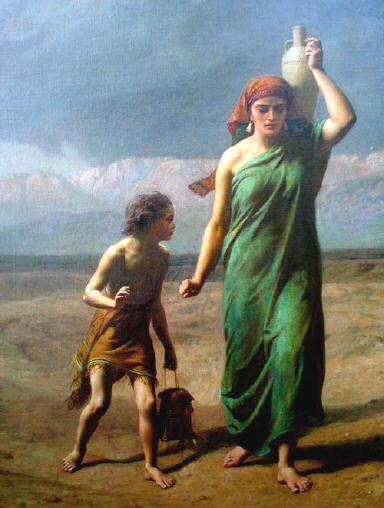
Hagar was an Egyptian maid of Abraham's wife Sarah. Sarah gave Hagar to Abraham for fertility purposes because she was infertile, saying "The Lord has kept me from having children. Go sleep with my maid-servant; perhaps I can build a family through her" (Genesis 16:2). Abraham and Hagar then had a son named Ishmael. Some time later God blessed Sarah and Abraham with a son named Isaac. Sarah ordered Abraham to send Hagar and Ishmael away by telling him "Get rid of that slave woman and her son, for that slave woman's son will never share the inheritance with my son Isaac" (Genesis 21:10). Abraham consulted God and God said that it was the right thing to do and not to worry because he "[would] make the son of the maidservant into a nation also, because he is your offspring" (Genesis 21:13). So Abraham sent Hagar and Ismael away and as they were traveling they got lost in the desert. Hagar left Ishmael under a tree while she went to find water. She was blessed by God who showed unto her a well. Hagar and Ishmael lived in the Desert of Paran where Ishmael became and archer and acquired a wife from Egypt.
The African American community uses this story to pertain to their life and their displacement. It also refers to a model of a single mother and her child trying to make a life although the struggles are great. This story is used by African Americans for the idea that anything can be done with only God on your side and it also creates the sense of true struggle that was and has been experienced by the African American community.
Subscribe to:
Posts (Atom)
